
Last Updated: October 29, 2026
Quick Summary
Cultural tourism shapes local communities by creating jobs, supporting local businesses and reviving traditions, but the outcome depends on who plans the visit, who earns from it and who has a say. Without those safeguards, costs like rising living costs, overcrowding and eroded culture can fall on residents who see little of the income.
- Cultural tourism can create employment and encourage local business growth, as seen in a southern Italian case study.
- Benefits concentrate with owners and operators while residents often absorb congestion, noise and rising rents.
- Visitor spending leaks out of destinations when accommodation, food and booking platforms are owned elsewhere.
- Ask your operator where the lunch was bought and who runs the accommodation to check local retention.
- Treat community caps on visitor numbers or photography limits as signs of a functioning governance system.
Table of Contents
- How Cultural Tourism Connects Visitors With Local Communities
- The Benefits of Cultural Tourism for Local Economies and Livelihoods
- The Negative Effects of Tourism on Local Communities
- Preserving Heritage, Traditions and Cultural Integrity
- Community-Based Cultural Tourism: Who Decides and Who Benefits
- Responsible Tourism and Local Communities: Measuring What Matters
- Planning Your Own Respectful Cultural Journey
- Frequently Asked Questions
Cultural tourism can lift a town's economy or quietly erode the traditions that drew visitors in the first place.
Heritage tourism alone accounts for 28.4% of total demand by tourism type, according to Future Market Insights cultural tourism market report. That scale means the way visitors engage with local places matters.
Here are seven ways cultural tourism shapes the communities it touches, and what travellers can do about each one.
How Cultural Tourism Connects Visitors With Local Communities
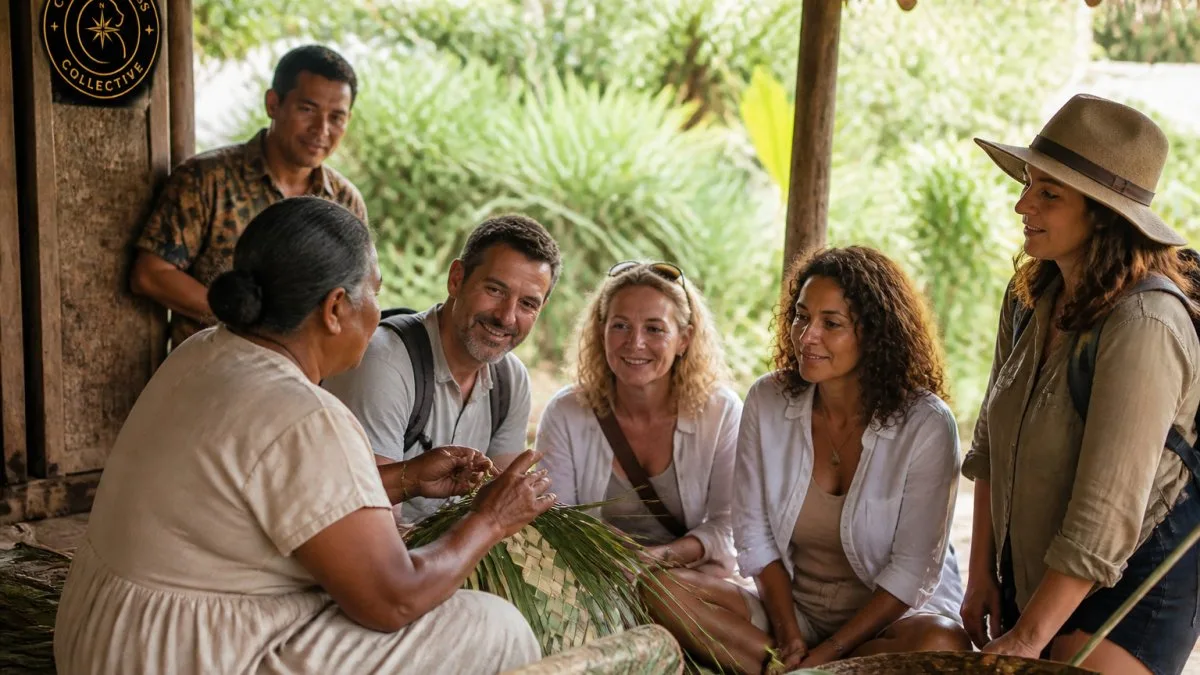
Cultural tourism connects visitors to a place through its living traditions, crafts, food, and stories rather than through monuments alone. Done well, it creates direct contact between travellers and the people who hold that knowledge.
A Flinders University thesis on tourism near cultural sites found both positive and negative impacts on residents living close to those attractions, a reminder that contact cuts both ways (Flinders University study on tourism impacts at cultural sites).
The Benefits of Cultural Tourism for Local Economies and Livelihoods
The clearest benefit is income. A regional case study in southern Italy found that developing cultural attractions to draw visitors created employment, encouraged local business growth, and helped revitalise urban heritage (ResearchGate case study on southern Italian cultural attractions).
Residents often point to improved employment and increased economic activity as gains. Those benefits only last when money stays local, so ask your guide where the lunch was bought and who runs the accommodation.
The article's regional case study points to several concrete economic gains from developing cultural attractions:
| Benefit | Source | Note |
|---|---|---|
| Employment | Southern Italian case study | Jobs created through cultural attractions |
| Local business growth | Southern Italian case study | Encouraged by visitor demand |
| Urban heritage revival | Southern Italian case study | Helped revitalise urban heritage |
| Alternative income sources | Cultural attractions | Offered alongside existing livelihoods |
The Negative Effects of Tourism on Local Communities
Tourism can strain the same communities it is meant to help, and the strain rarely falls evenly. Research published in 2026 links it to the erosion of local culture, higher crime in some areas, and environmental pressure such as pollution (Taylor & Francis framework for sustainable tourism). Those headlines are real, but they hide the more useful question: which residents carry the cost, and which capture the benefit?
The distribution problem: who gains and who pays
A common pattern in cultural tourism is that benefits concentrate while costs spread. Hotel owners, tour operators and landowners near a heritage site tend to capture the income. Residents who live beside the same site absorb the congestion, noise, waste and rising rents. Workers in visitor services often earn seasonal, part-time or informal wages with little security. Marginalised groups, including older residents, people on low incomes, and Traditional Owners who may not hold formal title, are frequently the least able to shape decisions and the most exposed to the downsides.
Three mechanisms drive most of the inequality:
- Leakage. A large share of visitor spending leaves the destination when accommodation, food, fuel and booking platforms are owned outside the community. The local share of each tourist dollar is often far smaller than arrival numbers suggest.
- Commodification of culture. When ceremonies, crafts or songs are packaged for paying audiences, the practice can shift from something a community does for itself to something it performs for others. Residents describe a loss of pride and dignity when this happens, even where income rises.
- Rising living costs. Visitor demand pushes up rents, land values and local prices. Residents on fixed or low incomes can be priced out of the very place tourism is meant to support.
Overtourism and pressure on living heritage
Overtourism is not only a crowding problem at famous landmarks. In cultural tourism it shows up as:
- Housing pressure. Short-stay accommodation converts long-term rentals into visitor lodging, tightening supply for residents and key workers.
- Infrastructure strain. Water, waste, roads and parking are sized for residents, not peak visitor loads.
- Sacred-site access. Crowds, photography and inappropriate behaviour can restrict access to places that remain central to ceremony and daily life. Some communities respond by closing sites to visitors entirely, or limiting numbers and times.
- Erosion of the visitor experience itself. When a place is overrun, the authenticity visitors came for is the first thing to go, a self-defeating loop.
A common mistake is assuming visitor numbers alone signal success. Crowds at a sacred site or a quiet village can do more harm than the revenue does good. The better test is whether residents would choose the same level of visitation if they were asked, and whether they have the power to say no.
What travellers can do
Ask your operator how many visitors a site receives at peak, whether residents were consulted, and where the money goes after it leaves your hands. Our practical guidance on respectful cultural tourism in Australia covers how to check these answers. Choose experiences that are owned locally, keep group sizes small, avoid peak times where a community has asked for breathing room, and respect closures and photography rules without negotiation.
Preserving Heritage, Traditions and Cultural Integrity
Tourism can support heritage. It can fund the revival of festivals, traditional cooking, and handicrafts that might otherwise fade. Tourism is increasingly used as a driver for keeping those traditions alive.
The risk is that a tradition performed for a tour bus stops being a living practice. The useful test is whether the community would keep doing it if no visitors came.
Community-Based Cultural Tourism: Who Decides and Who Benefits
Local communities are increasingly treated as strategic collaborators in tourism planning rather than backdrops for it. That shift matters because the people who live with tourism every day are best placed to say what should be shown, and what should stay private.
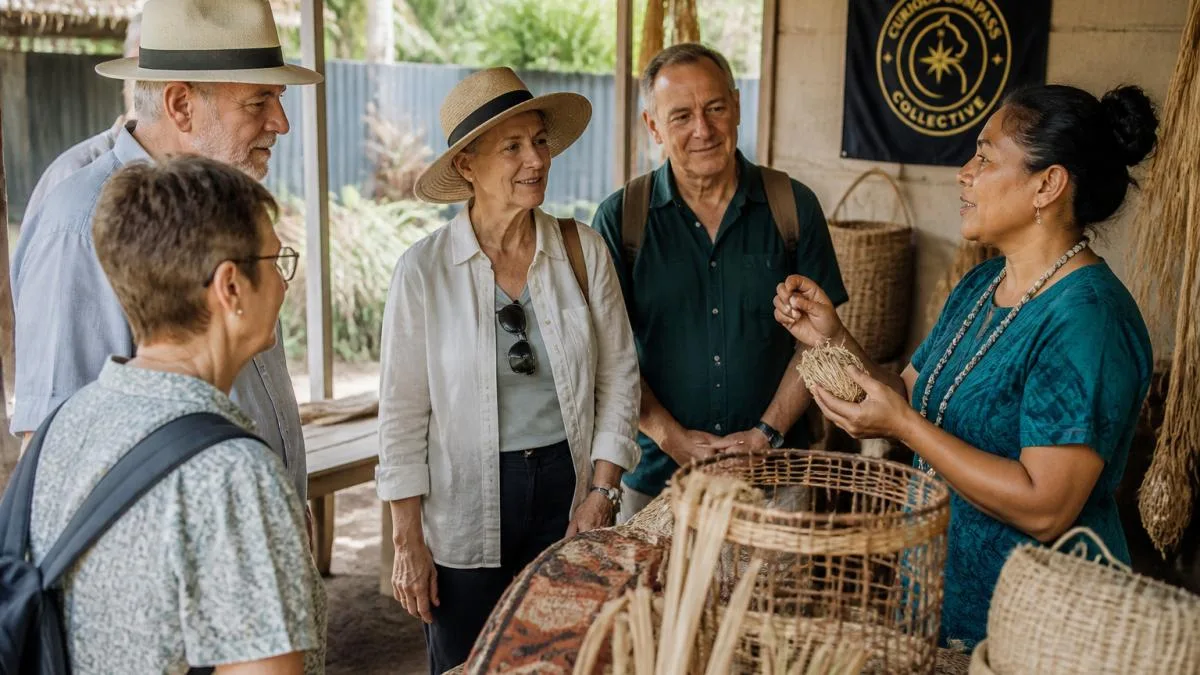
We look for operators who are owned or led by local people, who pay residents fairly, and who let communities set the limits on visitor access. Our guide to telling genuine Indigenous-led art tours from superficial ones explains what to look for.
Responsible Tourism and Local Communities: Measuring What Matters
Responsible tourism is hard to judge without measures, and most marketing gives you none. The useful move is to ask for a small set of practical indicators that any operator or destination manager can track. None of them require a research budget; all of them expose whether tourism is working for the people it affects.
A practical indicator set
- Local income retained. What share of each visitor dollar stays in the destination? A rough proxy is to trace the main spend lines, accommodation, food, guiding, transport, retail, and ask who owns each provider. Operators who can answer this clearly are usually the ones doing it well.
- Local employment quality. Count local residents employed in visitor services, then look at the nature of the work: full-time versus seasonal, award wages versus cash-in-hand, and whether supervisory and management roles are held locally rather than imported.
- Resident sentiment. Ask residents, not just visitors, whether tourism has improved their lives. Simple, repeated surveys, before and after a season, or before and after a new experience launches, reveal more than any single satisfaction score.
- Heritage condition. Track the physical and social condition of sites and practices: erosion at walking routes, wear on structures, whether ceremonies and crafts are still practised by residents for their own purposes, and whether access for Traditional Owners has been preserved.
- Carrying capacity. Estimate the visitor load a site or town can absorb before infrastructure, housing or heritage degrades, then compare actual peak numbers against it.
- Consultation and consent. Record whether residents were consulted before a new experience launched, who was consulted, and whether the community has a genuine ability to decline.
From measurement to mitigation and benefit-sharing
Measurement only matters if it changes behaviour. The strategies that consistently show up in well-run community tourism include:
- Local procurement. Commit to buying food, supplies and services from local businesses, and publish the proportion of spend that goes local.
- Community-owned enterprises. Favour models where residents hold equity or control, homestays, guiding cooperatives, community-run cultural centres, so profits recirculate rather than leak.
- Visitor codes and limits. Set and enforce caps on group size and daily visitor numbers, restrict photography and access at sacred sites, and close sites seasonally or for ceremony.
- Reinvestment mechanisms. Direct a defined share of revenue into heritage maintenance, local training or community funds, with residents deciding priorities.
- Fair work standards. Pay award wages, provide year-round contracts where possible, and train local residents for management roles rather than importing them.
Watch for overtourism
When visitor pressure on a living heritage site rises beyond what the community can manage, the damage often falls on residents who see little of the income. Housing pressure, infrastructure strain and restricted access to sacred sites are the clearest signals. Measuring these things is uncomfortable, but it is the only way to know whether tourism is working for the people it affects.
Our own standard is to keep groups small and pace itineraries slowly.
Planning Your Own Respectful Cultural Journey
Respectful travel starts before you leave.
Choose operators who can explain how their experiences benefit the community. You can find authentic Indigenous culture tours on Cape York in our guide to locally led experiences. Our packing list for an Aboriginal walking tour covers the practical essentials.
Cultural tourism can strengthen the communities it visits, but only when visitors arrive as guests who ask questions before they take photographs.
Frequently Asked Questions
Does cultural tourism help local communities? It can, through jobs, local business income, and support for traditional crafts and festivals.
What is community-based cultural tourism? It is tourism planned and run with local residents, who share in the decisions and the income.
Frequently Asked Questions
What is cultural tourism?
Cultural tourism is travel focused on experiencing a destination's heritage, traditions, arts, crafts, food and way of life. Rather than simply viewing monuments, visitors engage with people and places, often through guided visits, workshops, village stays or festivals. Heritage tourism is a closely related segment within the wider cultural tourism market. Its appeal lies in depth: the traveller learns why a place matters, not just what it looks like.
How does cultural tourism benefit local communities?
Cultural tourism can generate local employment, support small businesses and create income for artisans, guides and families who host visitors. Research from Flinders University (2019) found that tourism development near cultural sites produced both positive and negative impacts on nearby residents, so benefits depend heavily on how the activity is designed. Where tourism spending stays in the community, it can also help fund the revival of festivals, gastronomy and handicrafts, as Living Tours (2026) notes in its analysis of heritage preservation trends.
What are the negative effects of cultural tourism on local communities?
The main risks include the commodification of traditions, where ceremonies or crafts are reshaped to suit visitors and lose their meaning, and the erosion of residents' pride and dignity. Tourism can also widen income inequality, with benefits concentrating among a few operators while costs such as higher living expenses and crowding fall on everyone. Unmanaged tourism can be linked to cultural erosion, environmental pressure and rising local costs. Careful planning, resident consultation and visitor limits reduce these effects.
How can travellers support local culture responsibly?
Travellers can book locally owned tours and accommodation, buy crafts directly from makers, ask permission before photographing people or sacred sites, and spend time learning a few words of the local language. Choosing small groups and slower itineraries reduces crowding and gives more room for genuine exchange. Asking a tour operator how it works with local communities, and whether residents are paid fairly, is one of the most practical checks you can make before you book.

Frequently asked questions
What is cultural tourism?
Cultural tourism is travel focused on experiencing a destination's heritage, traditions, arts, crafts, food and way of life. Rather than simply viewing monuments, visitors engage with people and places, often through guided visits, workshops, village stays or festivals. Heritage tourism is a closely related segment within the wider cultural tourism market. Its appeal lies in depth: the traveller learns why a place matters, not just what it looks like.
How does cultural tourism benefit local communities?
Cultural tourism can generate local employment, support small businesses and create income for artisans, guides and families who host visitors. Research from Flinders University (2019) found that tourism development near cultural sites produced both positive and negative impacts on nearby residents, so benefits depend heavily on how the activity is designed. Where tourism spending stays in the community, it can also help fund the revival of festivals, gastronomy and handicrafts, as Living Tours (2026) notes in its analysis of heritage preservation trends.
What are the negative effects of cultural tourism on local communities?
The main risks include the commodification of traditions, where ceremonies or crafts are reshaped to suit visitors and lose their meaning, and the erosion of residents' pride and dignity. Tourism can also widen income inequality, with benefits concentrating among a few operators while costs such as higher living expenses and crowding fall on everyone. Unmanaged tourism can be linked to cultural erosion, environmental pressure and rising local costs. Careful planning, resident consultation and visitor limits reduce these effects.
How can travellers support local culture responsibly?
Travellers can book locally owned tours and accommodation, buy crafts directly from makers, ask permission before photographing people or sacred sites, and spend time learning a few words of the local language. Choosing small groups and slower itineraries reduces crowding and gives more room for genuine exchange. Asking a tour operator how it works with local communities, and whether residents are paid fairly, is one of the most practical checks you can make before you book.